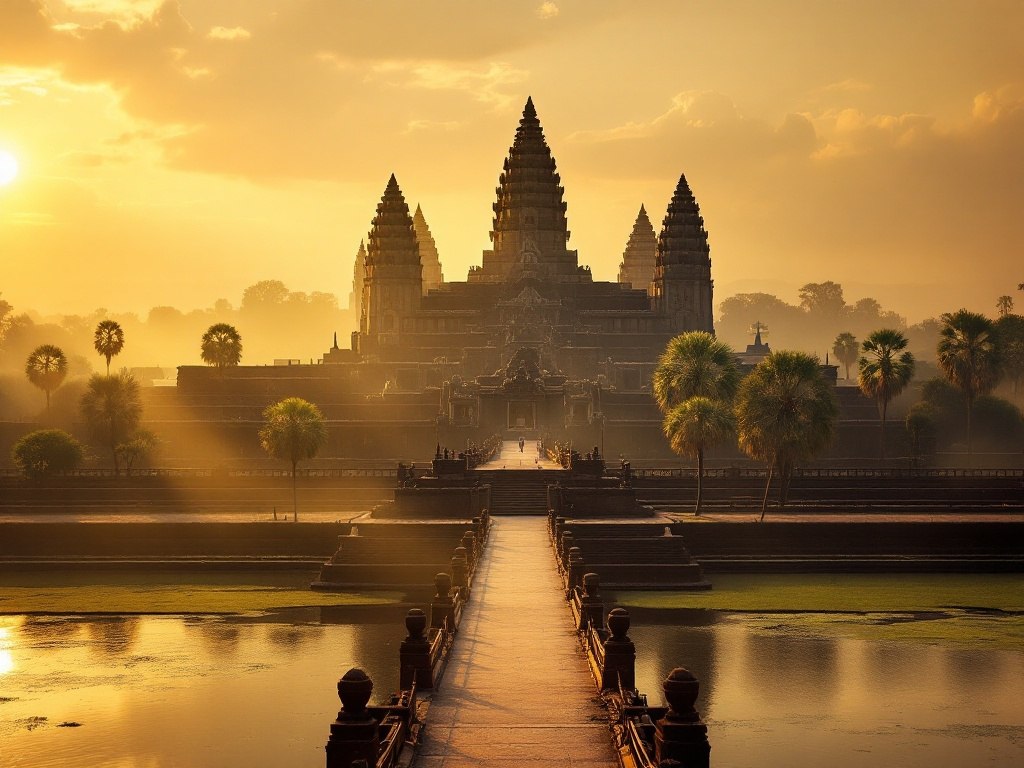
Angkor Wat
The largest temple ever built — a stone model of the cosmos that catches the equinox sun on its towers.
✦ Open on the living map — photos, stories & energiesIn the early twelfth century, Khmer ruler Suryavarman II ordered the construction of Angkor Wat as a grand Vishnu temple, its vast moat and galleries designed to mirror the universe itself. Over decades, tens of thousands of artisans carved narrative bas-reliefs depicting celestial battles, earthly kings, and the churning of the ocean of milk, embedding sacred geometry into every sandstone block.
The temple’s central towers were positioned so that on the spring and autumn equinoxes the rising sun crowns the highest spire, an architectural feat that still astonishes astronomers and energy workers alike. When the Khmer empire later embraced Buddhism, the site seamlessly became a place of Buddhist devotion without losing its original cosmic symbolism.
Best time to visit: November to February — reliably dry with comfortable temperatures and clear skies for equinox alignments; shoulder months of March and early November offer fewer crowds than the peak December–January holiday rush.
✦ Jade — Jade harmonizes the heart with the temple’s devotional current; carry it during sunrise walks to anchor compassion while the crown energies activate.
✦ Clear Quartz — Clear quartz amplifies the cosmic geometry of the towers; program it at the central sanctuary to hold the equinox light for later meditation.
✦ Moonstone — Moonstone attunes to the temple’s lunar feminine currents and supports gentle ascension; place it on the third eye while seated in the upper galleries.
✦ Amethyst — Amethyst strengthens the crown connection and protects against energetic overwhelm in such a powerful vortex; wear it when climbing to the highest level.
For metaphysical, spiritual & entertainment purposes — not medical advice. ✦ crystaloracle.ai