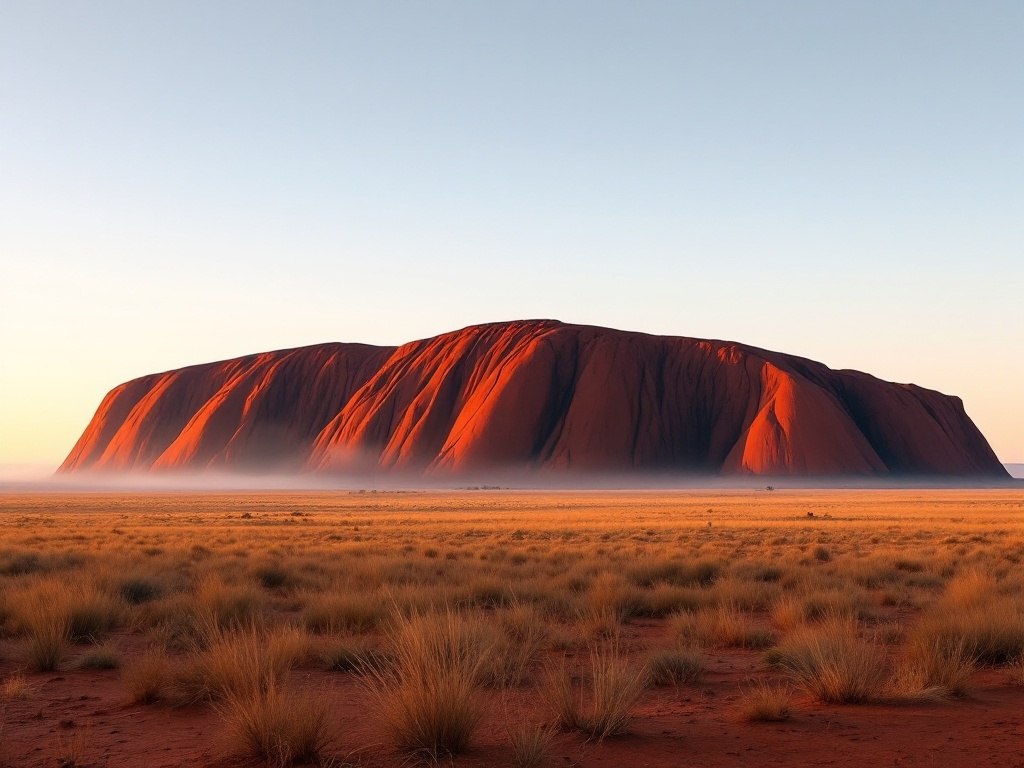
Uluru
A breathing red heart of the outback, woven into the Anangu songlines of creation.
✦ Open on the living map — photos, stories & energiesUluru, also known as Ayers Rock, stands 348 metres high and stretches more than three kilometres long in the heart of Australia’s Northern Territory. Geologists date its formation to roughly 500 million years ago, when layers of sediment hardened into arkose sandstone and were later tilted upright by tectonic forces. For tens of thousands of years the Anangu people have lived in its shadow, their Tjukurpa law explaining every cleft, waterhole and cave as the work of creator beings.
According to Anangu lore, the great rock was shaped during the Dreamtime by ancestral beings such as Kuniya the python woman and Liru the poisonous snake, whose battles left permanent marks on its surface. These stories are not myths to the traditional owners but living maps that guide ceremony, hunting and social law. The surrounding landscape is criss-crossed by invisible songlines that link Uluru to other sacred sites across the continent.
Best time to visit: May to September — mild daytime temperatures of 20–25 °C and cool nights; April and October are quieter shoulder months while June–August sees peak crowds and fully booked tours.
✦ Red Jasper — Red Jasper amplifies Uluru’s root and grounding energies; hold it during sunrise meditation to anchor your body to the monolith’s ancient pulse.
✦ Mookaite — Mookaite resonates with the Australian outback and Dreamtime wisdom; place it on the heart to receive gentle ancestral guidance while walking the base trail.
✦ Carnelian — Carnelian awakens creative life-force aligned with the rock’s fiery hues; carry it in your pocket to sustain vitality during the heat of the day.
✦ Smoky Quartz — Smoky Quartz deepens the grounding field of Uluru and transmutes heavy emotions; bury it briefly in red sand near the rock to charge it with songline energy.
For metaphysical, spiritual & entertainment purposes — not medical advice. ✦ crystaloracle.ai